Faith Community Safeguarding Checklist
Are you truly safe, or just covered?
A short, practical checklist to help you reflect on how safeguarding is experienced within your community - not just how it appears on paper.
Safeguarding is not always straightforward
Safeguarding within faith communities is often approached with care, commitment, and good intentions.
But harm rarely presents in obvious ways.
It can sit within trusted relationships, be shaped by power and influence, and remain unseen where there is a strong culture of trust, belief, or loyalty.
Many communities feel confident in their safeguarding until they are faced with a situation that is complex, uncertain, or difficult to interpret.
What this checklist is for
This checklist goes beyond policies and procedures to explore how safeguarding works in real situations, particularly where risk is less visible. It is designed to support reflection on how safeguarding is:
Understood
Recognised
Responded to
Lived in practice
What you’ll gain
By working through this checklist, you will:
Identify where safeguarding feels clear and embedded
Notice where there may be uncertainty or inconsistency
Recognise where risk may be harder to see or interpret
Reflect on how culture, relationships, and communication influence safeguarding
Who this is for
This checklist is for:
Faith leaders and leadership teams
Safeguarding leads within faith communities
Trustees and governance roles
Local authorities working alongside faith organisations
Anyone responsible for the safety and wellbeing of others within a faith setting
A different way of thinking about safeguarding
Safeguarding is not only about having the right processes in place.
It is about whether we can recognise risk when it does not present in expected ways.
This includes understanding how:
Trust and familiarity can obscure concerns
Power and spiritual authority can influence decision-making
Difference (including neurodivergence) can affect how risk is experienced, communicated, and understood
About this work
This checklist reflects the approach I take in my safeguarding work supporting organisations and communities to recognise and respond to risk where it is not always obvious.
I bring over 30 years of experience working with children, young people and families, both in the UK and internationally, including time as a manager at the NSPCC and in anti-human trafficking work.
My work focuses on strengthening safeguarding practice in areas where harm can be easily overlooked, including faith contexts, hidden vulnerability, and the impact of difference on how risk is understood.
Download the checklist
If this feels relevant to your work or community, you can download the checklist below.
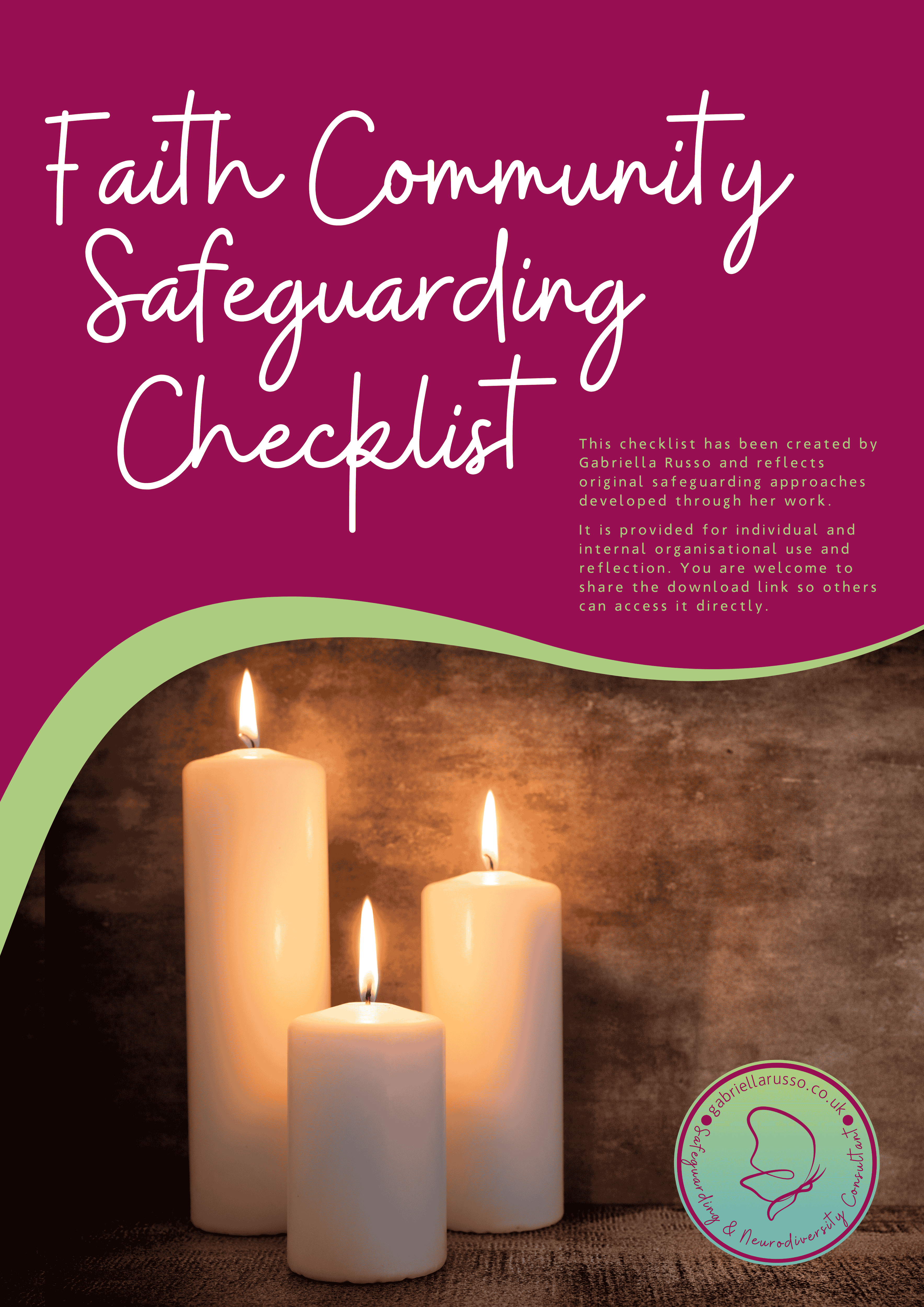
Your Faith Community Safeguarding Checklist
Please fill in your details and we will send your checklist directly to your email. You will be added to our mailing list to receive our newsletter and occasional offers, but please note your email is safe and we will not bombard you with spam or sell your address. And of course, you can unsubscribe at any time!



© 2026 gabriellarusso.co.uk