

Welcome, literary adventurer! Day 5 is here to prove you have more "voice" than a karaoke night and enough "style" to make Hemingway dab. So, what's all the fuss about voice and style in writing—are they twins, distant cousins, or mortal frenemies? Read on as we untangle this in a way only an authentic (and purposely witty) author website can.
Voice: Your Writerly Fingerprint (And Why It Can't Be Faked)
Picture your voice as your literary DNA: that irresistible blend of sass, sentiment, existential dread, and all the quirks that make people read your emails twice. It's what makes your writing feel like YOU, whether you're penning paranormal romance or a tax return. Voice emerges from your worldview, experiences, and what happens when you drink too much coffee and refuse to edit out your favorite adjectives.
Refer to Cheat Sheet 1: Voice vs. Style Quick Reference for a side-by-side breakdown that'll make this crystal clear.
If your author voice were a car, what would it sound like—muscle car growl, electric whir, whimsical airhorn? (Don’t worry, there’s a worksheet for that.)
Style: Your Toolbox of Literary Flourishes
If voice is your DNA, style’s your wardrobe—the technical, intentional choices you make to dress up your words. Sometimes you wake up minimalist (short, and wearing only the essentials), and sometimes “flamboyantly ornate” is on the menu (think Anne Rice on a bender in Versailles).
Refer to Cheat Sheet 3: Writing Styles Quick Guide for drama, poetry, and simplicity
For genre-specific flair, see Cheat Sheet 2: Genre Voice Expectations
Meet the Styles
Let's watch the same scene—a woman entering a coffee shop on a rainy morning—transformed by six different stylistic approaches:
Minimalist
Prose:
She pushed open the door. The smell: coffee, rain. People glanced up. She found a seat.
Dialogue:
"Coffee?"
"Black."
"That all?"
"That's all."
Short. Sharp. Every word earns its keep. No frills, no apologies.
Lyrical
Prose:
Rain painted silver rivers on the windows as she entered, the air inside blooming with rich espresso and the hum of quiet conversation; chairs cradled strangers in a soft, caffeinated hush, and her footsteps fell like whispers on worn wooden floors.
Dialogue:
"Would you like something warm?" he asked, his voice like honey stirred into tea.
"Always," she replied, as though answering something deeper than the question.
Poetic rhythm. Sound and imagery dancing together. Reads aloud like music.
Conversational
Prose:
You know that soaked, chilly feeling when you step into a coffee shop and everyone looks up like you're tracking in a hurricane? That was her. She grinned, picked a seat, and tried to stop dripping on the menu. The barista caught her eye—sympathetic, knowing.
Dialogue:
"Rough morning?"
"Is it that obvious?"
"You've got rain in your hair and determination in your eyes. So yeah, rough."
Friendly. Like texting a friend who gets it. Direct address, contractions, casual charm.
Ornate/Elaborate
Prose:
As she entered, propelled by the insistent rhythm of rain against cobblestone, the café revealed itself as a tapestry of aromas—roasted beans mingled with wet wool, laughter swirling in little arabesques around the golden light, every detail fussily patterned by fate and caffeine, the very air thick with possibility.
Dialogue:
"I find myself in perpetual awe of the manner in which you navigate life's tempestuous circumstances," he mused, his fingers tracing the rim of porcelain.
"You always make everything sound like a Victorian novel," she laughed, elaborate and genuine.
Rich descriptions. Adjectives everywhere, and they're supposed to be there. Complex sentences with multiple layers.
Formal/Academic
Prose:
Upon entering the establishment, she observed a marked contrast between the inclement weather outdoors and the warmth therein. Ambient scents of coffee and subdued conversation occupied the space. Her positioning at a table adjacent to the north-facing window was notable for its strategic advantage regarding observation.
Dialogue:
"I would appreciate a beverage of moderate temperature."
"What type of beverage would satisfy your requirements?"
"The standard preparation would be acceptable."
Professional. Precise. Passive voice and objective observation. Perfect for research papers and your dissertation.
Stream of Consciousness
Prose:
Door. Wet. Her shoes—squeak, squash. Coffee, somewhere, above the noise. Words float: someone laughs, windows shimmer, her thoughts dart—sit. Find a seat. Don't look. Just sit. Rain in her hair, rain in her mind, everything dripping, dripping, the smell of it all pressing in, warm and cold and real and—breathe.
Dialogue:
"You okay?"
"I—yes. No. Coffee helps. Coffee helps everything, doesn't it?"
"Sometimes. Not always. But sometimes."
Interior thoughts as they happen. Fragmented. Raw. Non-linear logic, minimal punctuation, authenticity over grammar.
Matching Voice and Style to Genre (Yes, Genres Care!)
Every genre wants something different from you—Romance loves pink prose and heartbeats, Thriller prefers you talk fast and leave out the lights, and Literary Fiction wants you to flex those metaphors like they're biceps.
Let's see how the same coffee shop scene (and its dialogue) changes by genre:
Romance
Prose:
The world shrank to the curve of his fingers as he handed her the steaming mug, their laughter swirling in the warmth between them, the rain outside suddenly irrelevant—all that mattered was the heat rising between their hands, the spark of recognition.
Dialogue:
"I've been waiting for you," he whispered, his thumb brushing her cheek.
"I know," she breathed, and meant it in every language her heart knew.
Emotional. Sensory. All about connection, chemistry, and feelings that make your chest ache.
Thriller
Prose:
The moment she entered, every head snapped toward her. The lights seemed too bright; the coffee, scalding. Someone was watching. She could feel it—a presence at the back of her neck, cold as a gun barrel. Her pulse quickened. The door behind her felt very far away.
Dialogue:
"You came," he said flatly. It wasn't a question.
"I had no choice," she replied, each word measured, careful.
"There's always a choice. You chose wrong."
Tension. Urgency. Short sentences building dread. Dialogue stripped of pleasantries, loaded with threat.
Memoir
Prose:
The rain that morning felt like permission. Inside the café, I counted each step as proof I was, finally, moving forward. The warmth hit me like an old friend—one I'd forgotten I needed. I ordered coffee the way my grandmother taught me: strong, no apologies, exactly how I wanted it.
Dialogue:
"You look different," my friend said.
"I feel different," I admitted, and for once, it felt true.
"Good different?"
"Honest different. That's the same thing, isn't it?"
Honest. Reflective. Personal and true. Uses "I," invites the reader into memory and emotion.
Literary Fiction
Prose:
She entered as though crossing a threshold into another world—one where the ordinary became luminous, where a cup of coffee held the weight of revelation, where strangers' faces reflected her own unnamed longing. The rain outside seemed to fall not on the street but on her consciousness, each drop a question she'd been avoiding.
Dialogue:
"Do you ever feel like you're supposed to be somewhere else?" she asked the stranger beside her.
"Always," he said, without hesitation. "But I think that's what it means to be alive—wanting to be elsewhere while actually being here."
Introspective. Layers of meaning. Reader, bring your thinking cap. Philosophical undertones in every exchange.
For hands-on practice, try our worksheet: Style & Tone Practice
Matching Voice and Style to Genre (Yes, Genres Care!)
Every genre wants something different from you—Romance loves pink prose and heartbeats, Thriller prefers you talk fast and leave out the lights, and Literary Fiction wants you to flex those metaphors.
And if you’re “between genres”? Bonus points for rebellion! But seriously, knowing who you’re writing for (or against) helps your voice and style shine.
Develop Your Voice: Embrace the Journey
Writing is like self-discovery with more typos. Your first draft may sound like Shakespeare’s sidekick—or like you, on a weekend binge—but the journey to discovering your true voice is the stuff legends (and long blog posts) are made of.
Here's the roadmap:
Step 1: Write a lot, even if half ends up in the "delete" pile.
Step 2: Read extensively; steal only what you can twist to match your personality.
Step 3: Experiment with style—try minimalist one day, lyrical the next.
Step 4: Use the Voice Discovery Exercise worksheet to see who you really are on the page (spoiler: it's better than you think).
Step 5: Reference the visual below for an 8 step path you can follow.
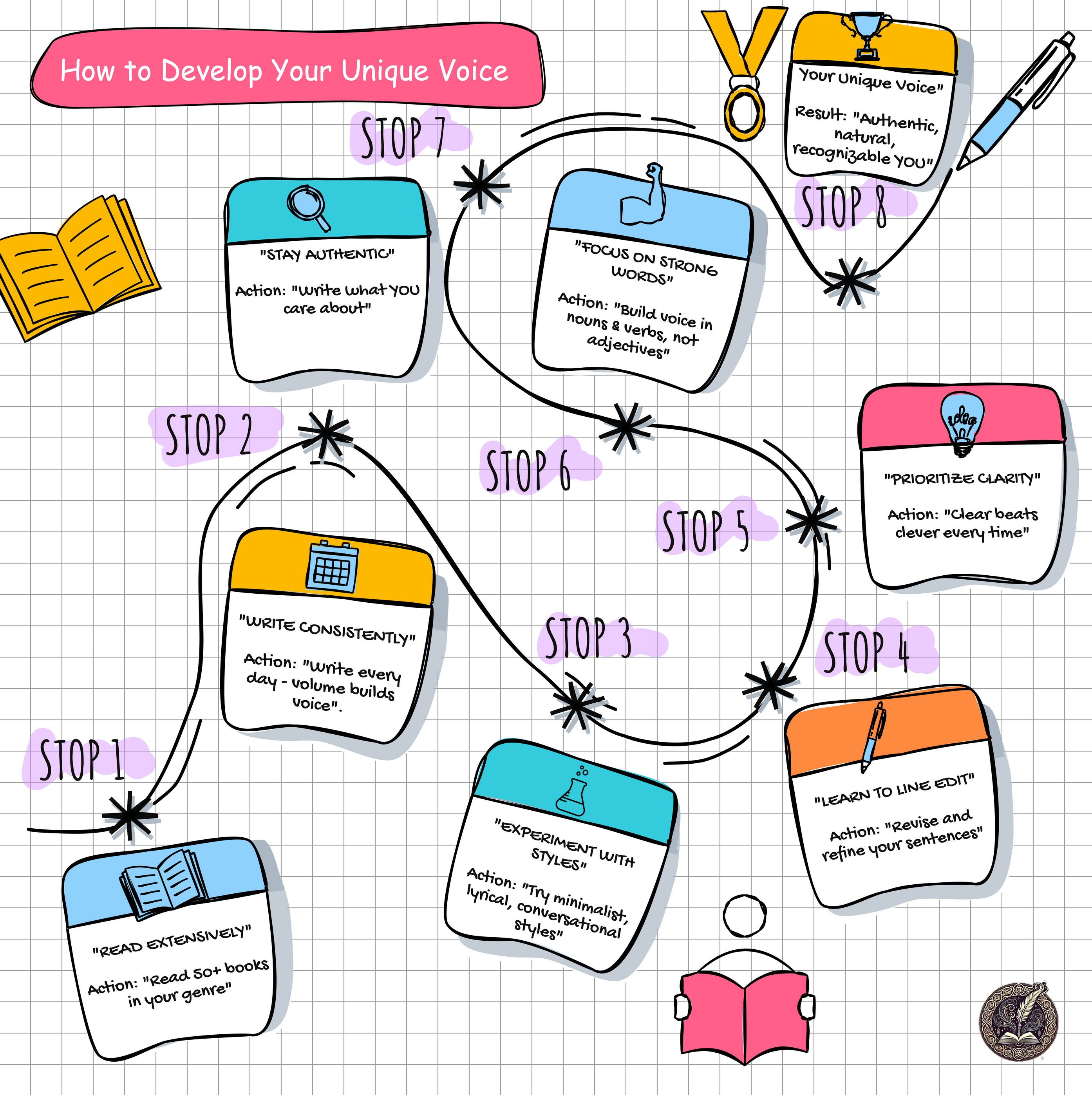
Want a roadmap? Grab Diagram: The Voice Development Journey
TL;DR (But Written in a Voice You’ll Never Confuse)
Your voice is who you are. Your style is how you show up in words. Marry them wisely, dress for your genre, and never lose sight of you—especially on your best awkward writing days.
Now go forth—and let your voice ring out, in whatever style suits you today. And don’t forget to reference the downloads and diagrams: your literary selfie awaits.





© 2025 Lisa A. Moore. All rights reserved.