
Burnproof Academy
How to stop staff burnout as a supervisor in the social impact space
Become one of the few supervisors in the social impact space who can actually stop employee burnout before it starts.
This program is for you if:
Your main goal is to execute on the mission of your organization, but burnout is getting in the way of your team's effectiveness
You want to support your team better, but you haven’t gotten specific training on how to deal with burnout specifically
You believe there’s a solution out there, but forums, blogs and self care trainings don’t offer any long-term fixes
You’re not afraid to make changes to how you operate, but you don’t know where to begin
You want to help your team but you’re struggling with stress yourself
What if...
...you could identify exactly which of your employees are at highest risk of burnout
and then help them become masters of their own experience while creating a culture for your staff to thrive?
...by doing this, you burnout-proof yourself
and are able to focus more on the work that fulfills you?
...YOU could be the solution to burnout
rather than fancy EAPs, because you understand the research and psychology behind burnout prevention better than 99% of people in your field?
That's what Burnproof Academy provides.

Hi there, I’m Chelsea.
I started burning out at a nonprofit job that I had loved and soon left the organization for another promising position. Unfortunately, things weren’t better in my new job, and I burned out so badly that I couldn’t participate in the workforce for 5 years.
Since recovering, I’ve learned what causes burnout and how to prevent it based on the latest research, and I now know exactly what both of my supervisors in those positions could have done differently to change my trajectory so I wouldn’t have burned out. I’ve taken that knowledge and created the Burnproof Academy so you can stop burnout before it infects your team members and you’re stuck managing turnover for your entire career like most supervisors in the nonprofit world.
Here’s what you’re getting and why it will make a difference:
Six 90-minute group coaching sessions over three months
Coaching is one of the most powerful tools for professional development because it's about integrating knowledge on a personal level. Training by itself often doesn’t stick long term or allow for exploring personal application, so combining it with coaching creates a powerful approach of tailoring techniques and strategies to your unique situation.
SESSION 1: Preventing your own personal burnout as a supervisor so you can support others better
SESSION 2: Cultivating community to buffer against the isolation that feeds burnout
SESSION 3: Creating a sense of control amid frequent stressors for staff
SESSION 4: Improving productivity despite challenges in the work
SESSION 5: Tapping into intrinsic motivation to protect against disengagement
SESSION 6: Review and integration for moving forward after the program
Training videos in between sessions
In order to dedicate as much live session time to coaching, you'll receive training videos in between sessions that will prep you for personalized coaching during our calls.
Bi-weekly Zoom call format
Enjoy the convenience of gathering virtually (and feel free to eat lunch while you’re at it!) with coaching sessions that are spaced just enough apart that it's not taking too much time but close enough together that you can maintain momentum.
Built-in action planning and accountability
Session layout guarantees practical application of what you've learned as you create action plans during your sessions and then report on your progress during the next call. This can then be compiled into a report to show your supervisors the progress you've made during the program.
Peer connections via group coaching
Join with your peers who are experiencing similar struggles and have goals to grow in the same way you do (Discussions with other people who empathize with your exact situation and are also trained in burnout prevention is priceless...)
Support from me in between sessions
Feeling stuck trying to apply what you had planned since the last session? Reach out. I’m here to help.
Templates and tools
These resources will help you apply what you’ve learned while organizing your learning and integrating insights that you receive from training/coaching.
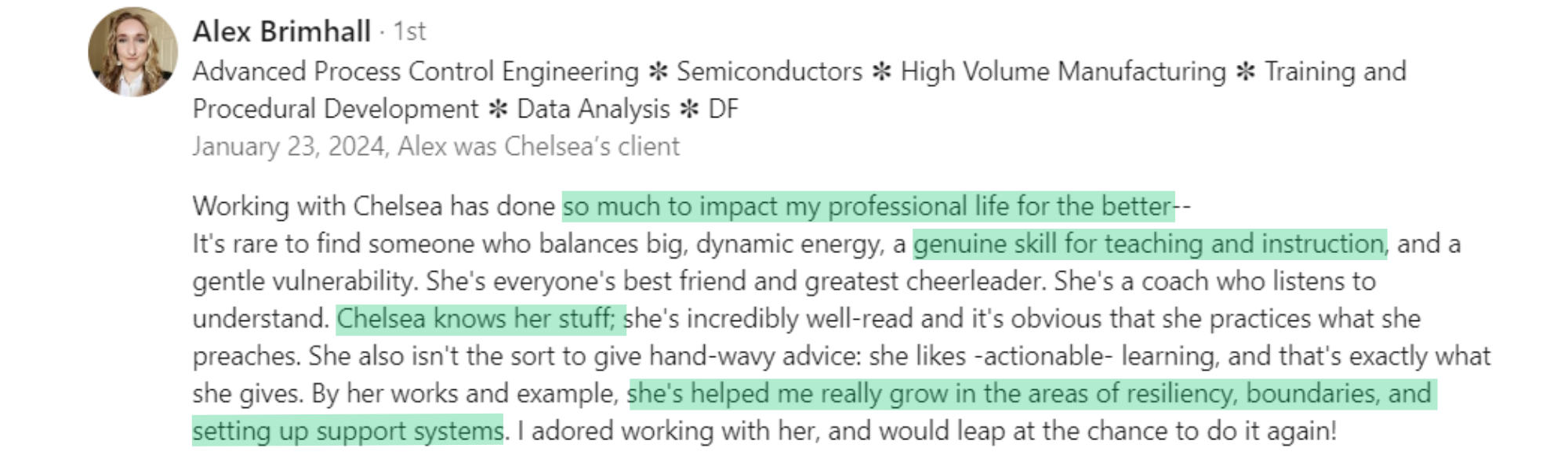
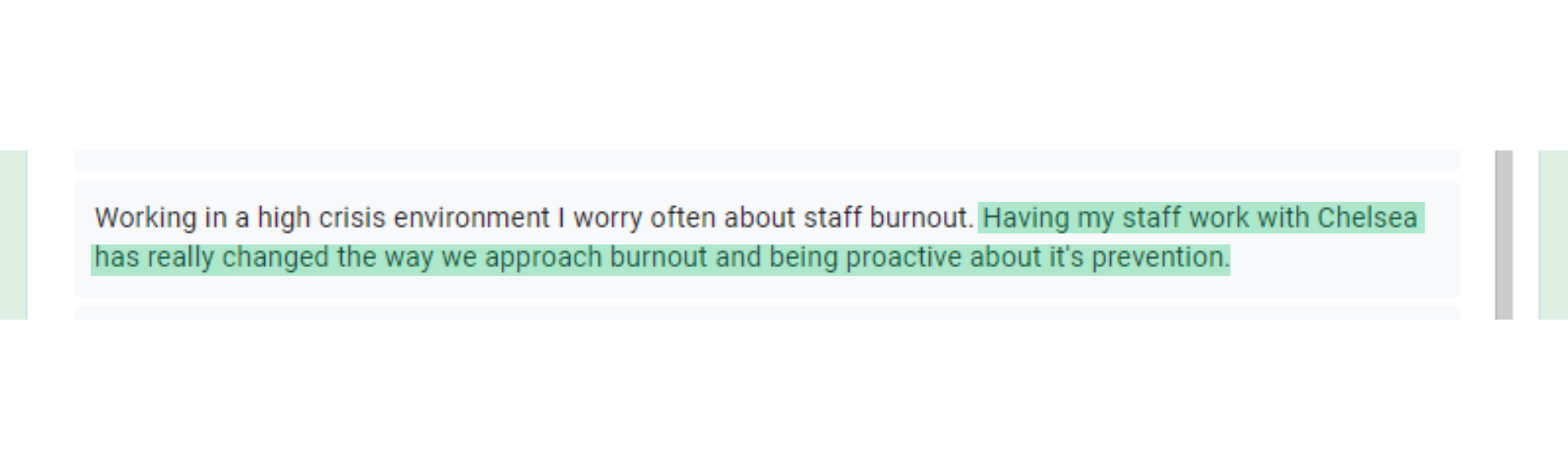
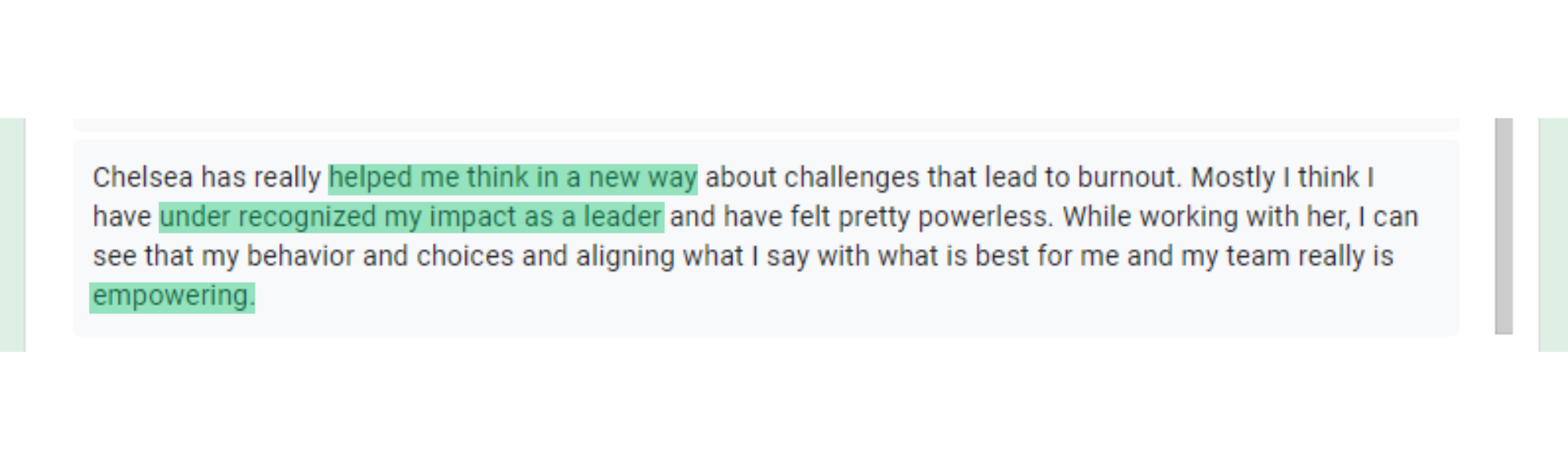
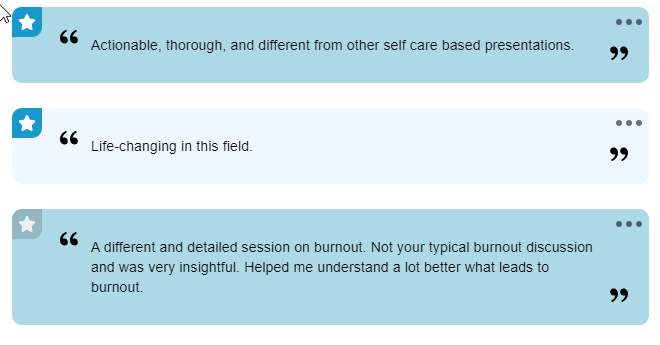
Nice things that other social impact supervisors have said about this program:
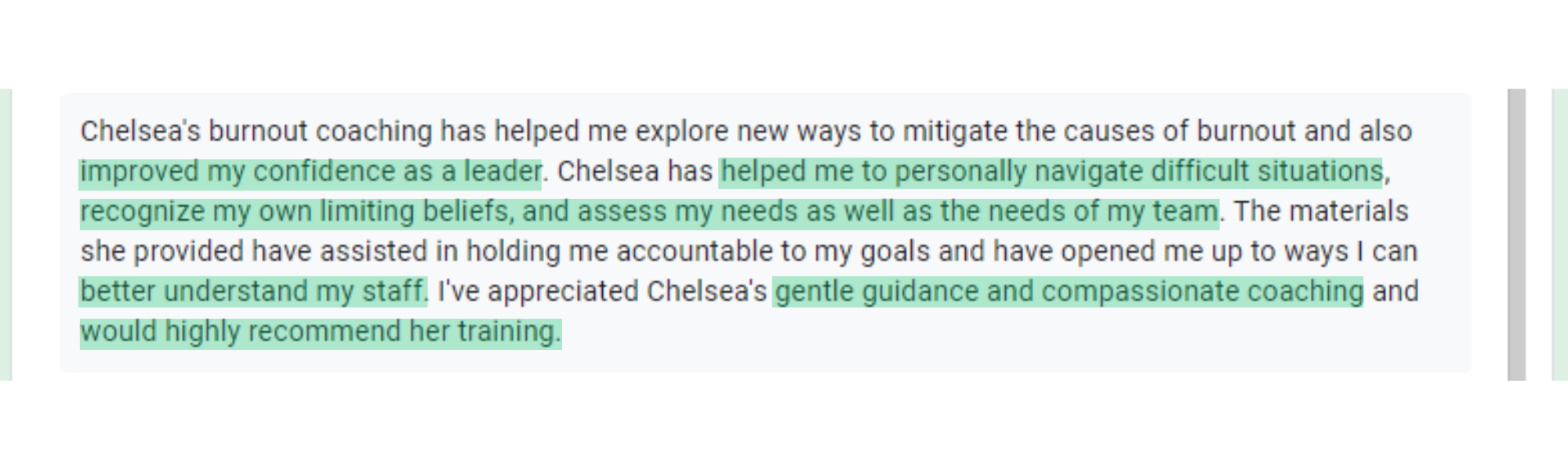
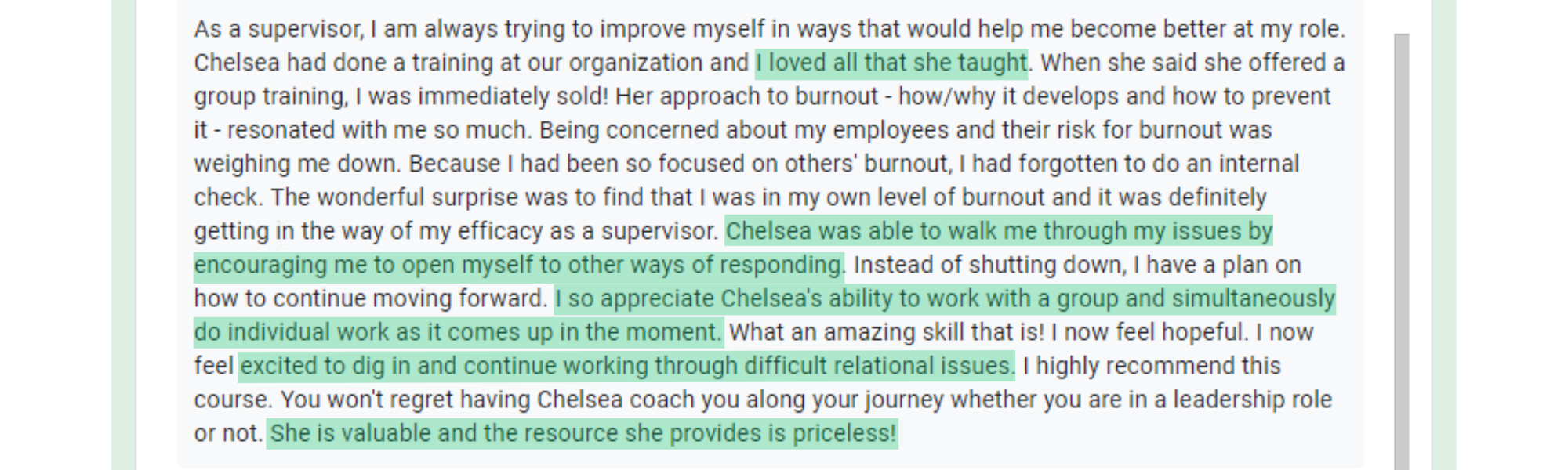
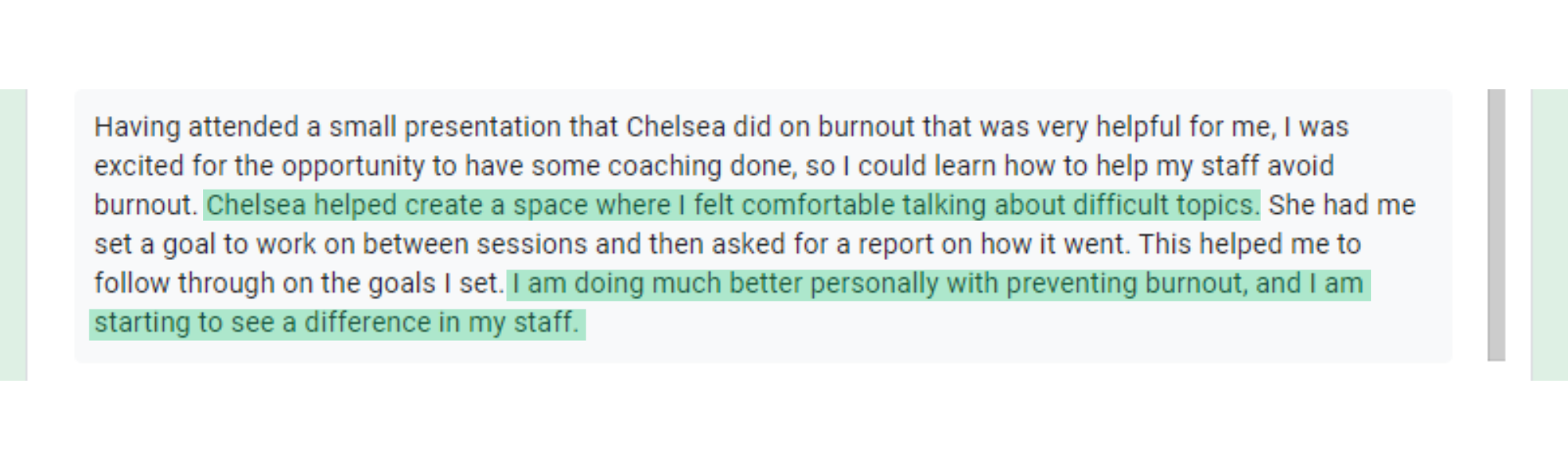
This is an opportunity to invest in yourself, your team, and your career.
FAQs for participants:
Much of what is taught about addressing burnout falls under treatment or recovery, whereas this training is specifically focused on prevention so that you can reduce the need for those services. Additionally, in the social impact world, burnout is often equated with compassion fatigue, but burnout can result from a variety of sources and compassion fatigue is only a narrow aspect of it.
This program combines the latest research on burnout from Gallup and international universities with prevention science principles from the public health sector to help you actually reduce the incidence of burnout instead of just managing it as it occurs. You will learn how to approach burnout on your team from a preventionist perspective by combining management skills with an understanding of risk and protective factors and then applying practical interventions to prevent your direct reports from burning out. This is a professional development program and does not focus on things like self care.
Start the conversation early in case multiple people need to be consulted or funds need to be moved around. Send an email to your decision makers or ask to speak in person. Outline the program for them – title, dates, format, cost, registration deadline. Share your specific concerns about burnout on your team and outline the benefits this program would provide specifically to you, your team and your organization (feel free to copy/paste details from the "FAQs for decision makers" below). If necessary for your position, describe how your work will be handled during the hours you're in each session. Let them know you'll have a deliverable report on your progress for them to see at the end (this will be based on your action/accountability plans that we work on in each session). You might also offer to prepare a presentation to give to your office that covers key takeaways. Follow up with your decision makers in advance of the early bird discount and the registration deadline.
FAQs for decision makers:
Chelsea is a Certified Executive Coach with training in organizational development from the University of Utah. She’s been trained in prevention science by Applied Prevention Science International and has led multiple county- and city-wide prevention initiatives. She’s trained dozens of organizations on mental health and has been featured in health and education conferences for her work in prevention and burnout.
Gallup states that “Managers are the single most important factor in the engagement and performance of your workforce.” Unfortunately, many supervisors begin supervising with very little training and it creates a trickle-down effect of problems. By investing in professional development for those in supervisory positions, not only are they more likely to stay in the position, their personal growth will reduce burnout in their staff which will result in improved productivity and morale. Of all my services, this course is the lowest investment you can make for this level of impact for your organization.
Based on average nonprofit turnover rates, between a third and half of donor dollars may be used to manage turnover resulting from burnout rather than delivering on the organization's mission. A 2024 survey showed that 74% of nonprofit staff are considering getting a new job this year. One of the most common reasons that people said they were NOT going to look for new work is because of having management that supports them well. By receiving training on both management skills and burnout prevention, supervisors in your organization can significantly increase retention.
Burnout happens at the intersection of both individual and environmental factors and not because either member of that relationship is "the problem". Blame is not conducive to progress, so I teach my clients to be understanding of personal/systemic difficulties, have a solution-oriented mindset, and take responsibility for the things that they uniquely can control.
Burnout is increasing across the globe. Very few supervisors have more than a superficial understanding of what burnout is, and most react to it rather than getting ahead of the curve so that their teams can actually thrive. Elevate yourself above the average social impact professional by getting on the cutting edge of prevention science as it applies to burnout.
You have two choices:
1.
You can continue to have a burnt out workforce with only a rudimentary understanding of how to support them, which will probably be the case in most of the social impact organizations where you work moving forward...
2.
Or you can equip yourself with the knowledge and skills necessary to prevent you and your team members from burning out, making it so that you have a better working experience and greater selling points on your resume as you move forward in your career.
The summer cohort for the Burnproof Academy has closed, but let me know if you're interested in future cohorts!
Any applications received after June 14 will be added to a waitlist and you will be notified when future opportunities are available. Submitting an application does not commit you to participation - it's only an indication of interest.